Connection Comes First
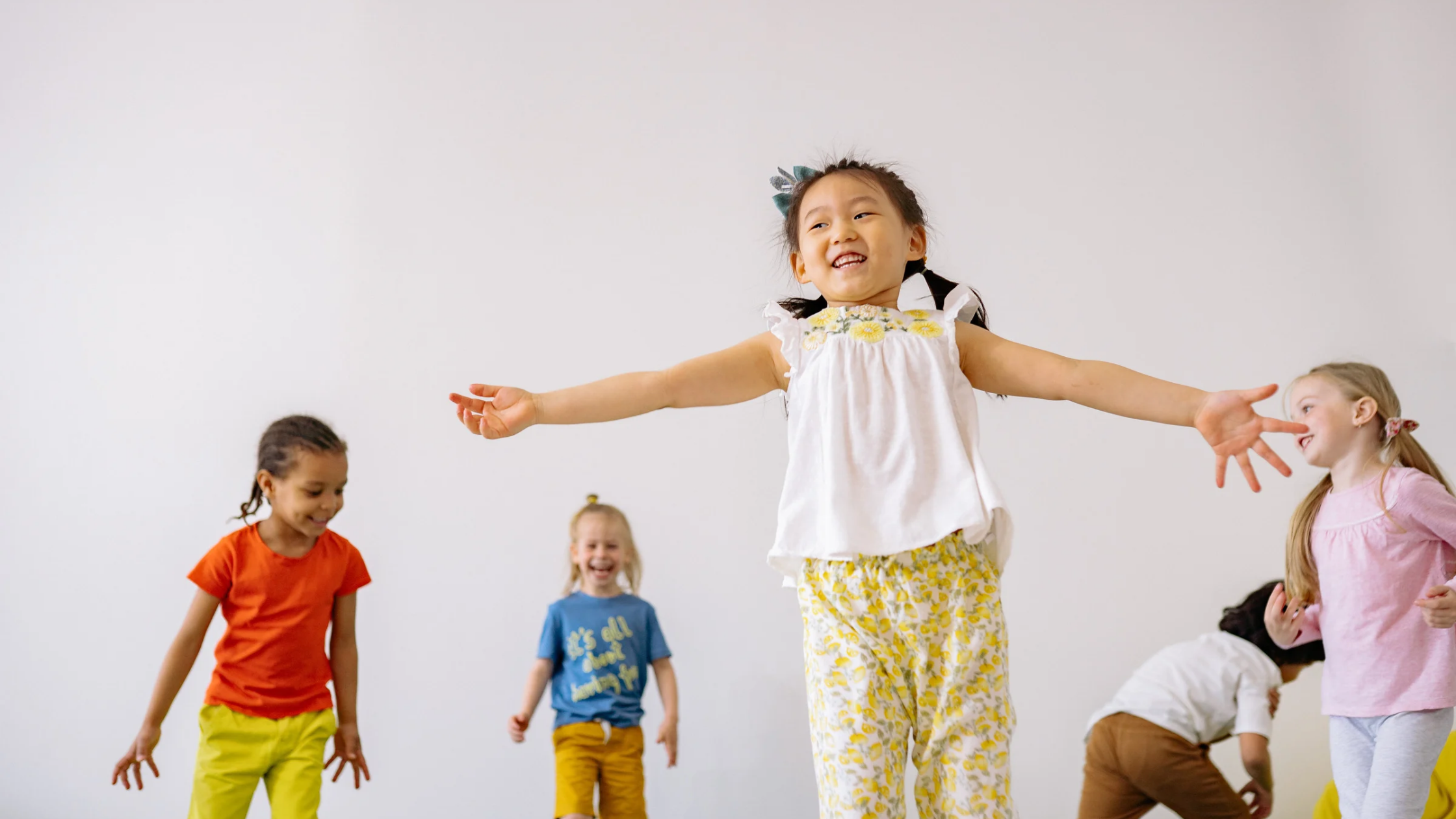
How everyday connection and movement help children learn to manage themselves
I was raised in a household where one parent yelled and the other stayed calm and quiet. My personality was to yell back when yelled at. My sister's was to withdraw. Same household. Different responses. Whether those responses come from temperament, experience or some combination of both, there is one universal truth: We cannot help a child calm down if we are not calm ourselves.
Self-regulation is the ability to manage our thoughts, emotions and behaviors in ways that allow us to respond appropriately to what is happening around us. We tend to think this is something children will learn automatically but how likely is that if it is never modeled for them? Or, better yet, explicitly taught.
Co-Regulation
Before children learn to self-regulate, they rely heavily on co-regulation, the process of becoming regulated through interaction with another person. Babies can't tell themselves that everything is going to be okay. They experience it through being held, rocked, fed, spoken to and comforted. Over thousands of these interactions, their developing nervous systems begin learning what safety and regulation feel like.
Famed psychiatrist Dr. Bruce Perry describes how early neural systems involved in regulation, relationships and reward become wired together through experience. When a caregiver responds consistently and lovingly, a child begins developing an internal expectation that people are safe, predictable and caring.
Anyone who has tried reasoning with a child in the middle of a meltdown knows how ineffective logic can be. There is a physiological reason for that. When children become overwhelmed, the parts of the brain responsible for reasoning, planning and impulse control become less available. Daniel Siegel and Tina Payne Bryson describe this as losing access to the brain's "upstairs" functions. Connection comes first. Reasoning comes later. Our tone of voice, facial expression, posture and touch can help a child move toward a state where thinking becomes possible again.
Keeping the Body in Mind
There is another tool available to us that we often overlook: movement.
The body is constantly sending information to the brain. A churning stomach, tense shoulders, racing heart or restless legs can signal distress before a child has the language or awareness to tell us what is happening. Siegel and Bryson describe this flow of information from the body upward through the brain as an important part of our emotional experience.
Young children seem to understand this instinctively. They rock, bounce, wiggle, run, climb, spin and crawl under things. We often interpret all that movement as something a child needs to control. But movement is the body’s solution to an attention problem.
Movement gives children opportunities to practice body awareness, coordination, attention and modulation. Stanley Greenspan connected motor development with attention and executive functions such as planning and sequencing. His recommendations included activities involving balance, coordination, crawling, marching, hopping, jumping and skipping, along with games that require children to shift between fast and slow or loud and quiet.
The good news for families is that none of this requires expensive equipment or special programs. It looks like play.
Build Regulation Into Everyday Play
Move together. Put on music and dance. Play follow-the-leader. March around the kitchen. Crawl across the floor together. The goal isn't exercise. It is shared movement, attention and connection.
Change gears. Play games that alternate between fast and slow, loud and quiet, moving and freezing. Red Light, Green Light and Freeze Dance require children to notice a cue and change what their bodies are doing in response.
Cross the body. Crawl, march while swinging opposite arms, draw giant figure eights or toss a ball from one side of the body to the other. These activities give children practice coordinating movements and planning what their bodies will do next.
Challenge balance. Walk along a curb. Hop from one pillow to another. Stand on one foot. Build an obstacle course out of furniture and couch cushions. Let children experiment with their bodies and encounter challenges they can work to overcome.
Find a rhythm together. Clap a pattern and have your child repeat it. Pat-a-Cake. Drum on the kitchen table. Walk together to a beat. Rhythm combines movement, attention and connection.
Children's bodies are designed to explore, move, experiment and connect. We don't have to manufacture development every waking minute. We can create environments that foster what kids already need and want.
References
Greenspan, S. I., & Greenspan, J. (2009). Overcoming ADHD: Helping your child become calm, engaged, and focused without a pill. Da Capo Press.
Perry, B. D., & Winfrey, O. (2021). What happened to you? Conversations on trauma, resilience, and healing. Flatiron Books.
Siegel, D. J., & Bryson, T. P. (2011). The whole-brain child: 12 revolutionary strategies to nurture your child’s developing mind. Delacorte Press.
Join the Movement
updates, activities, and info.